What the percentage measures
For a straightforward flour-and-water dough, hydration is the weight of water divided by the weight of flour, multiplied by 100. It is a ratio against flour, not the percentage of the dough’s total weight that happens to be water.
King Arthur Baking’s explanation also counts the flour and water carried by a sourdough starter or preferment. That small detail can change the answer considerably.
The calculations below explain the arithmetic. They are not complete recipes: salt, leavening, fermentation, shaping and baking instructions would still be needed to make a loaf.
Example one: a dough without starter
Suppose the formula contains 500 grams of flour and 350 grams of water. Divide 350 by 500 to get 0.70, then multiply by 100. The hydration is 70%.
If the same flour amount is used with 325 grams of water, the calculation is 325 ÷ 500 × 100 = 65%. Moving from that mixture to 70% requires another 25 grams of water. That is a rise of five percentage points in hydration.
For a target calculation, reverse the process. With 600 grams of flour at 70% hydration, the water amount is 600 × 0.70 = 420 grams. Weighing both ingredients makes these comparisons direct; volume measures introduce another variable.
Example two: include the starter
Now take 500 grams of added flour, 350 grams of added water and 100 grams of starter at 100% hydration. Here, 100% means the starter contains equal weights of flour and water, so its contribution is 50 grams of each.
The total flour is 550 grams. The total water is 400 grams. The dough’s hydration is therefore 400 ÷ 550 × 100, or about 72.7%. Calling it 70% would overlook the starter.
If you wanted 70% hydration while keeping 500 grams of added flour and that same 100 grams of starter, total water would need to be 550 × 0.70 = 385 grams. After subtracting the starter’s 50 grams of water, you would add 335 grams. These examples assume that the starter’s stated hydration is known.
Use the number alongside the flour
Two doughs with the same hydration can handle differently. King Arthur’s comparison of bread and all-purpose flours explains how protein content affects dough strength and water absorption. Its hydration guide also discusses differences associated with whole-grain flour.
Start with the flour specified in a tested recipe and record any substitution. Avoid changing flour, water and fermentation timing together if you want to understand which adjustment made a difference.
Hydration is especially helpful for keeping notes. Record the flour, measured water, starter contribution and how the dough handled. The number makes that record easier to compare next time; it does not rank one style of bread above another.
Connect the calculation with the loaf
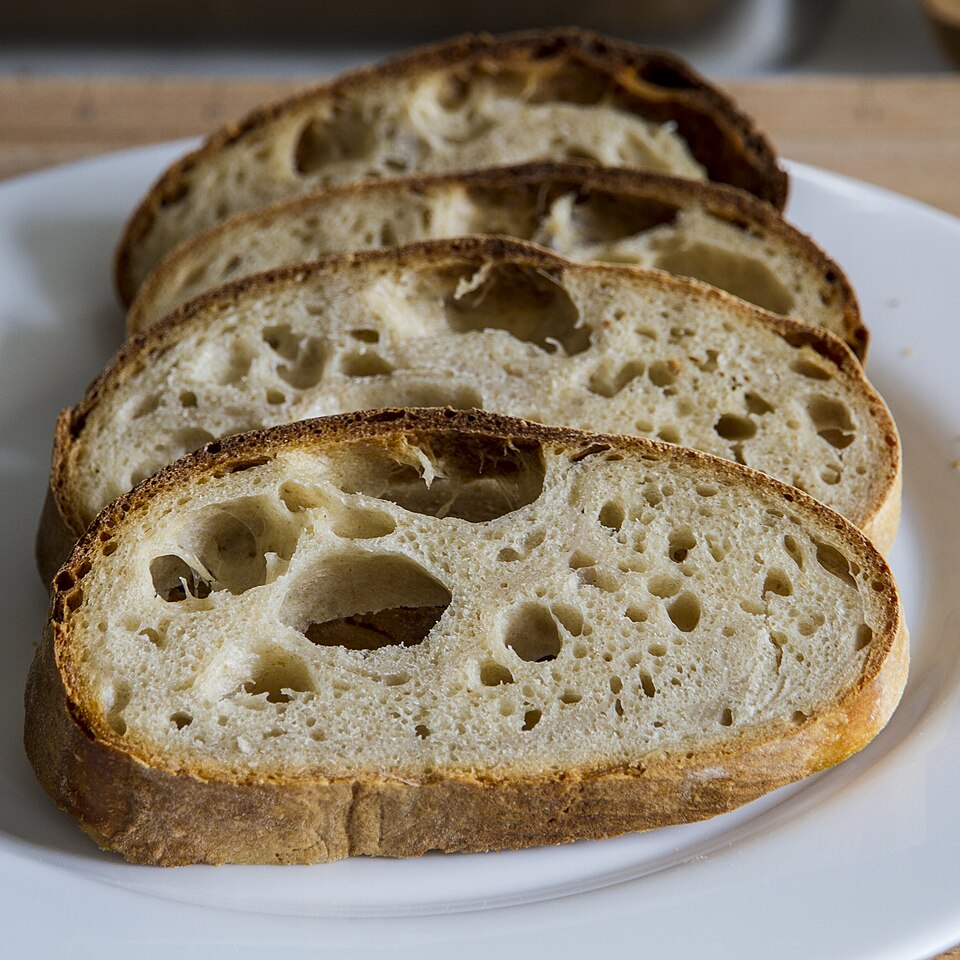
Look at the bread you actually want to eat: a sandwich loaf, a crusty table bread or something else. Choose a recipe designed for that result rather than selecting the highest hydration you can find.
Our Proserpina Bakehouse photo story offers a view of bakery work. The arithmetic here is a separate practical tool: a way to ask a more precise question about a recipe and record a more useful answer after baking it.